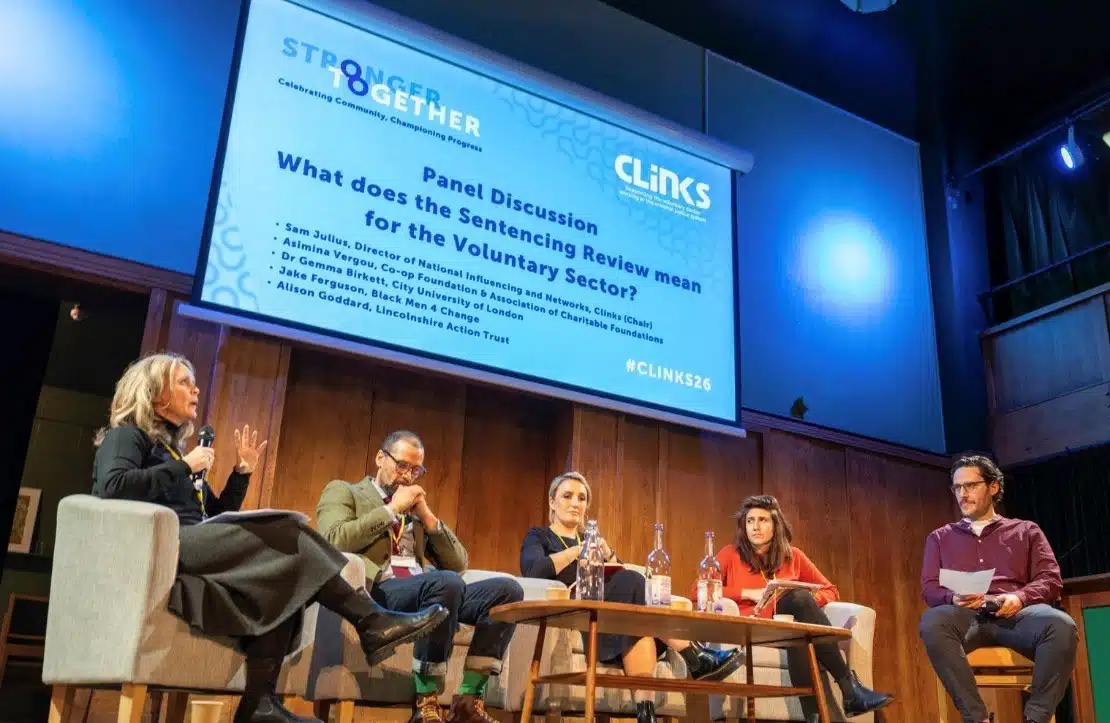
Earlier this week, our Chief Executive, Alison Goddard, joined a panel at the national Clinks conference, to discuss what the Sentencing Review means for the voluntary sector. Her thoughts are detailed below.
The Sentencing Act became law on 22nd January 2026. Cited as ‘once in a generation’ opportunity, the Sentencing Bill contains a lot of potential, with a welcome focus on reducing re-offending, effective resettlement and keeping the public safe, whilst addressing prison capacity issues.
Green shoots of potential include:
A focus on the root causes of offending, including diversion for young people and on first time offending is welcome. This will require buy-in from other stakeholders e.g. police to engage with out of court disposals, bail support, liaison and diversion etc. This is key area of activity for VCS providers, and there is scope to do much more as the use of problem solving courts increases for example.
A focus on rehabilitation through community alternatives to custody, which we know are more effective and less disruptive than short prison sentences; a presumption that sentences less than 12 months are suspended; improved rehabilitation interventions in custody; earned progression to give prisoners a reason to engage in meaningful activities. Again, core areas of activity for VCS organisations
A refocusing of women’s justice through deferred sentences; gendered responses to support; a commitment to sustainable funding for women’s centres; provisions to consider pregnancy, caregiving, and experiences of domestic abuse in sentencing and bail decisions. As a charity that delivers a number of services for women, LAT is particularly hopeful for the focus on sustainable, long-term funding for women’s centres, which is currently a fragmented and insecure postcode lottery
We do have a number of concerns however:
- The presumption against custodial sentences of less than 12 months gives significant risk of up-tariffing, which has been highlighted continuously, and is particularly a risk for women I feel.
- For many of the planned developments to work, robust community alternatives are needed, and need to be funded properly and sustainably. The current recommissioning of CRS services is one element of the potential tapestry of interventions, however the proposed 8 year contracts, at the same value as now and with no planned indexation over that term will mean many VCS organisations will be unable to engage with this opportunity. How do smaller, specialist and local providers engage with opportunities that are often national or regionally focused, and present financial risk?
- Buy-in from sentencers and other Government departments / local authorities etc will be key – the idea that decisions of local stakeholders, whether that be about commissioning services, social value, eligibility criteria or sentencing decisions, directly impact local communities, is missing currently. Earlier this week the government announced a centralisation of police force areas; women’s CRS services are planned to be let as multi-county contracts; Probation and prison regions are constantly growing – there is a move away from local. Crime is a local issue, and needs local solutions – VCS organisations are uniquely placed to understand and offer those solutions, given the opportunity. Better and broader use of pre-sentence reports would create this line of sight for magistrates. I’ve spoken with several magistrates who have never been inside a prison for example – they have no concept of what happens to an individual when they are taken to prison and the impact this has on their life and that of their families, or of the community alternatives that could be more effective in addressing the needs that led to the offending. The reintroduction of local Criminal Justice Boards would also assist with local accountability and ownership.
- Finally, the elephant in the room – funding. MOJ’s social media campaign last Friday publicising the passing of the Act focused on the prison building programme and a £700 million investment in Probation, with no mention of the voluntary sector. I fear with MOJ’s limited Spending Review allocations, funding may not stretch beyond Probation, electronic monitoring and additional prison places
The success of the Act, and whether it achieves it’s potential for all stakeholders, will therefore depend on the implementation, not the intention
Latest news & updates
-
 08 March 2026
Celebrating International Women’s Day: Give to Gain
-
 09 February 2026
Creating Belonging for Children with a Parent in Prison